How to Join an Affiliate Program
Quick answer: To join an affiliate program, you pick a program that fits your content, fill out its application honestly (most just ask for your website, social account, or content platform and a short description of how you’ll promote them), wait for approval — often instant, sometimes a few days — and then get your unique tracking link from your dashboard. You don’t need a huge audience or a perfect website. You need a real (even small) platform and a clear, specific answer to “how will you promote us.”
Introduction
You’ve decided you want to try affiliate marketing. Maybe you’ve picked a niche, maybe you’ve got a small blog or social account started. Now you’re staring at an application form for an affiliate program, and it’s asking questions you’re not totally sure how to answer.
This is the part that trips up more beginners than almost any other step — not because it’s technically hard, but because nobody explains it clearly. Most guides talk about choosing a niche and picking a platform, then jump straight to “you’re approved, here’s your link,” skipping the actual application and approval process in between.
This guide fills that gap. We’ll walk through exactly how to join an affiliate program, what programs are really asking for when they review your application, the difference between joining an individual program and joining through an affiliate network, and what to do if you get rejected the first time.
What Actually Happens When You “Join” an Affiliate Program
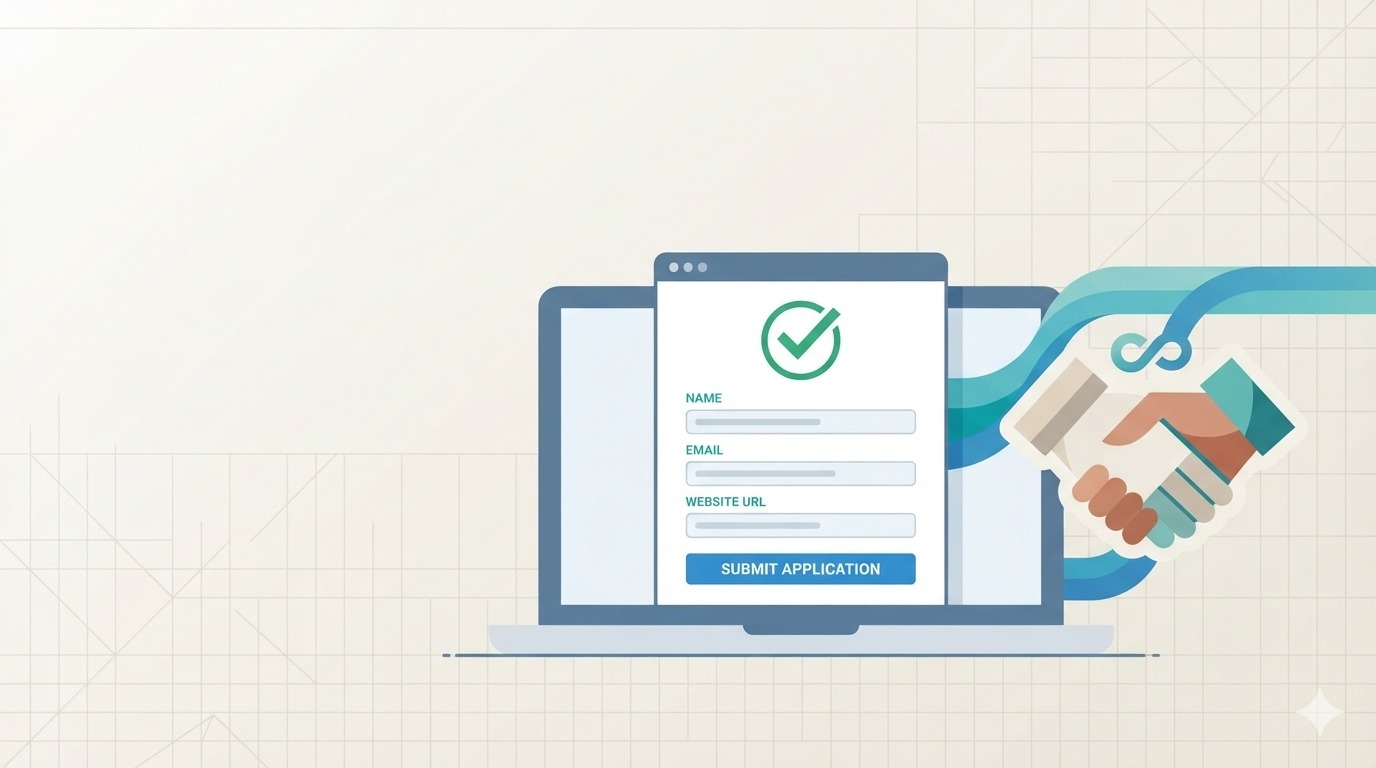
Joining an affiliate program means applying for permission to promote a company’s product or service and earn a commission for sales or actions (like signups) that come through your unique tracking link. It’s not automatic — most programs review applications, even if the review is quick.
There are two paths to joining:
Individual affiliate programs. You apply directly on the company’s own website — Canva, Grammarly, and most SaaS tools work this way. You’ll usually find a link at the bottom of their homepage labeled “Affiliates,” “Partners,” or “Referral Program.”
Affiliate networks. Instead of applying to one company, you create a single account on a network — ShareASale, CJ Affiliate, Awin, or Impact are common examples — and that one account gives you access to hundreds of individual programs running through that network. You still apply to each individual program inside the network, but you only set up payment and tracking details once.
Neither path is objectively better. Individual programs sometimes have simpler applications; networks give you more programs to browse in one place, at the cost of an extra signup step upfront.
How to Join an Affiliate Program: Step by Step
Step 1: Have something to show, even if it’s small
The single biggest reason beginners get rejected isn’t lack of experience — it’s applying with nothing published yet. A program reviewing your application has almost nothing to evaluate if your blog has zero posts or your Instagram has zero content.
You don’t need months of history. A handful of genuine posts, videos, or pins that show what kind of content you actually make is usually enough for most beginner-friendly programs. If you haven’t published anything yet, our guide on how to become an affiliate marketer walks through picking a niche and a platform first — that’s the step that comes before this one.
Step 2: Decide between an individual program and a network
If you already know exactly which one or two companies you want to promote, check their own website first — going direct is often the simplest route. If you’re not sure yet, or you want access to many programs without filling out a dozen separate applications, a network is the more efficient starting point. Our Amazon Associates vs. SaaS affiliate programs comparison is a useful reference if you’re weighing a large marketplace program against a smaller, higher-commission software program.
Step 3: Read the program’s requirements before applying
Some programs publish minimum traffic requirements or content guidelines; many don’t require anything specific at all. Either way, five minutes reading the program’s affiliate page before applying tells you whether you’re actually a fit — and saves you from a rejection that a little research would have predicted.
Step 4: Fill out the application specifically, not vaguely
This is where a lot of applications fail, quietly. “I’ll post on social media” tells a reviewer nothing. Instead, be specific: what platform, what kind of content, how often, and why this program fits your audience. A sentence like “I run a weekly newsletter for new parents and want to recommend baby-monitor and sleep-training products I’ve researched” gives a reviewer something concrete to say yes to.
If you’re applying through a network for the first time, expect to fill out an account-level profile (your niche, your main platform, your traffic estimate if you have one) once, and then a shorter, program-specific note for each individual program you apply to inside it.
Step 5: Wait for approval — and know what “normal” looks like
Approval times vary a lot. Some programs (many Amazon-style retail programs) approve near-instantly. Others — especially SaaS, finance, and premium brands — manually review every application and can take anywhere from a day to a couple of weeks. A slow response usually just means a human is reviewing a queue, not that something’s wrong with your application.
Step 6: Get your tracking link and understand disclosure
Once approved, you’ll find your unique affiliate link inside a dashboard — sometimes called a “partner portal,” “affiliate center,” or similar. From there, you can usually generate links for specific pages, not just the homepage.
One rule applies no matter which program or network you’re using: you must disclose that your links are affiliate links. This isn’t optional. It’s a trust issue with your readers and, in most places including under FTC guidance in the US, a legal requirement. A simple line like “This post contains affiliate links — I may earn a commission if you purchase through them, at no extra cost to you” covers the basics.
Individual Programs vs. Affiliate Networks: A Quick Comparison
| Individual Program | Affiliate Network | |
|---|---|---|
| How you apply | Directly on the company’s site | One network account, then apply per program |
| Setup time | Fast for one program | Slightly slower upfront, faster for each program after |
| Best for | You already know exactly who you want to promote | You want to browse and compare many programs |
| Payment | Handled by that one company | Handled centrally by the network |
| Examples | Canva, Grammarly, most SaaS tools | ShareASale, CJ Affiliate, Awin, Impact |
If networks are new to you, our upcoming guide on how affiliate networks actually work goes deeper into how tracking, applications, and payouts function across a network account.
Common Mistakes When Joining an Affiliate Program
- Applying with an empty or near-empty platform. Publish a small amount of real content first.
- Copy-pasting the same vague application to every program. Reviewers can tell, and it reads as low effort.
- Applying to programs that don’t match your content at all. A finance program is unlikely to approve — or convert well on — a cooking blog, and it wouldn’t be a good fit even if it did.
- Giving up after one rejection. Most programs allow you to reapply after 30–90 days, once you have more content built up. A rejection usually means “come back later,” not “never.”
- Ignoring the terms once approved. Every program has rules about where and how you can promote — read them, because breaking them (even unintentionally) can get you removed.
- Skipping disclosure. Beyond the legal requirement, undisclosed affiliate links are one of the fastest ways to lose reader trust once people notice.
What to Do If You Get Rejected
Rejection at this stage is common and rarely personal. If a program allows it, ask why — some will tell you specifically (not enough content, niche mismatch, traffic below their threshold). If they don’t give a reason, the most common fixes are: publish more content first, apply to a program that fits your niche more precisely, or simply wait and reapply once your platform has grown.
In the meantime, look for a program with a genuinely lower barrier to entry — many free, beginner-friendly programs exist specifically because they don’t require an established audience. Our high-paying affiliate programs roundup is a useful place to compare options once you’re ready to apply broadly rather than to just one program.
A Note on “Starting Your Own” Affiliate Program
If what you’re actually looking for is the reverse of this guide — you run a business and want other people to become affiliates for you — that’s a different process entirely, covered in our guide on how to start an affiliate program for your business. This article is written for the affiliate side: joining someone else’s program, not launching your own.
Frequently Asked Questions
Do I need a website to join an affiliate program? No. Many programs accept a YouTube channel, an Instagram or TikTok account, or a newsletter instead. A website tends to help with approval odds and long-term traffic, but it isn’t a strict requirement for most beginner-friendly programs.
How long does it take to get approved for an affiliate program? It varies widely — some programs approve within minutes, others take days or a couple of weeks for manual review. Larger, higher-commission programs and finance-related programs tend to review more carefully and take longer.
Can I join more than one affiliate program at once? Yes, and most affiliates eventually do. The common advice — and it holds up — is to start with a small number of programs that genuinely fit your content rather than applying broadly to everything at once, since a handful of well-matched programs typically converts better than a long list of unrelated ones.
What’s the difference between an affiliate program and an affiliate network? An individual program is run by one company, and you apply directly to them. A network is a marketplace that gives you access to many individual programs through a single account, so you don’t have to sign up separately with each company.
Is it free to join affiliate programs? Yes, legitimate affiliate programs are free to join. Any program that asks you to pay an upfront fee to become an affiliate is a red flag worth treating with real caution.
What happens if my application is rejected? Most programs allow reapplication after a waiting period, commonly 30–90 days, once you’ve built up more content or a slightly larger audience. It’s rarely a permanent no.
Conclusion
Joining an affiliate program isn’t complicated once you see the actual steps: have something real to show, pick between an individual program or a network, apply specifically rather than vaguely, and disclose your links once you’re approved. It’s a process, not a gate — and it’s one almost every beginner gets through with a little patience and a genuinely matched program.
If you’re still deciding which niche or platform to build around before you get to this step, our guide on how to become an affiliate marketer covers that groundwork. And if you’d rather keep learning on the go, the Learn Affiliate Marketing app is a straightforward way to work through beginner concepts like this one from your phone, between the steps of actually applying to your first program.
Want to keep learning without sitting at a desk? The Learn Affiliate Marketing app breaks down beginner concepts — like the application and approval process covered in this guide — into short, phone-friendly lessons you can work through between steps, whenever you have a few minutes. It’s a practical way to keep building your understanding as you actually start applying to your first programs.